With a fixed happiness “baseline,” what’s the point in trying?

One of the most striking findings from the booming new field of happiness research has been that people have fairly sticky baselines. With only a few exceptions, people tend to return to the same level of happiness over time, regardless of what happens to them — even extremely good events like winning the lottery, or extremely bad events like becoming a paraplegic, only seem to bump people’s reported happiness up or down for a limited time, before they start to drift back to their baseline. (Dan Gilbert is one of the leading happiness researchers right now; I highly recommend his book, Stumbling on Happiness. Here’s a NY Times review of it that discusses some of the relevant issues.)

That leads to a puzzling question: If people seem to end up just as happy when things don’t go as they wished, then why knock ourselves out striving for the outcomes we think will make us the happiest? Why not just shrug and say “que sera, sera,” abandoning our pursuit of our goals, on the reasoning that we’re going to end up roughly as happy no matter how things turn out?

Giving up certainly seems like a bad idea, intuitively. But how do we reconcile that with the evidence? I’ve been able to come up with three possible reasons why it’s still a good idea to keep striving for happiness despite the empirical evidence that it doesn’t make much difference:

(1) It’s possible that the people who say they’re equally happy even though their circumstances seem objectively worse are not, in fact, equally happy. That is, maybe they have lowered their expectations of what maximum happiness is, so that even when they rate their happiness an “8” their scale is actually squished compared to the scale of better-off people who rate their happiness an “8”.  Illustration:

So let’s say Person A seems to be worse-off than person B, but they both rate their happiness an 8. Well, person A’s 8 is roughly equivalent to person B’s 5.5, but person A doesn’t know it because she thinks the maximum level of happiness possible is roughly what person B would consider a 7.

(2) It’s also possible that the reason why the people who didn’t get what they wanted are just as happy, on average, as the people who did get what they wanted, is that a lot of people are wanting the wrong things. If you reason more carefully than the average person does about what’s going to make you happy, then it makes sense that when you get what you’re pursuing you actually will be happier than other people are when they get what they were pursuing. For example, I am pretty confident that I wouldn’t be much happier with an income of $200,000 than I would be with an income of $60,000. The evidence suggests that’s true of most people, and yet most people don’t realize it — so there are a lot of people out there making sacrifices for a higher income that isn’t actually making them happier.

(3) There’s a lot of evidence that your happiness immune system (the one that convinces you you’re happy even though you didn’t get what you want) only kicks in when you’re stuck, when you don’t have any chance of changing the situation anymore. For example, in one of Gilbert’s studies, he allowed photography students to choose one of their photos to turn into a framed print. Half of them were given the option to change their mind later; the other half were told their choice was final. The latter group was significantly happier with their choice than the former group.

Or to use another of Gilbert’s examples:

“The psychological immune system works best when we are totally stuck, when we are trapped. This is the difference between dating and marriage, right? I mean, you go out on a date with a guy, and he picks his nose; you don’t go out on another date. You’re married to a guy and he picks his nose? Yeah, he has a heart of gold; don’t touch the fruitcake. Right? You find a way to be happy with what’s happened.”

Knowing you have the option to switch means that you’re always wondering if the grass might be greener on the other side of the hill; having no option to switch means your natural happiness immune system kicks in and reassures you that, no, the grass probably wasn’t greener over there anyway. So if I were to give up striving for any particular outcome, my back-up system might not kick in, because I would always have the uncomfortable knowledge that I could improve things if I tried.

Stigma and Perception of Attractiveness: Strange Finding

Ever gone on a date only to find out that they’re secretly a shoplifter? Did you find them more or less physically attractive after that? Via NCBI ROFL (a great blog for quirky science), I found out that there was a study about negative information’s effect on how attractive undergrads found smiling and nonsmiling faces. If the person was described as bad for one reason or another, would they be less attractive?

I haven’t read the article, but the abstract is interesting. As expected, smiling faces were more attractive overall than non-smiles. The researchers were looking at the impact of the negative information, and gender differences appeared:

Analysis indicated that smiling faces were rated more attractive than nonsmiling faces, consistent with previous research. There was a significant interaction of participants’ sex and target description, in which women rated smiling faces less attractive after exposure to negative information about the target, but men rated smiling faces more attractive after exposure to negative information.

Well, that makes perfect evolutionary sense. After all, men would look for…

Just kidding. I’m not going to make up an evolutionary just-so story. If I had to make a guess with very low confidence, I’d say it’s more likely a socialized phenomenon anyway.

The different negative facts were one of these:

  • Convicted of insider trading on the stock market
  • Commits adultery on a regular basis
  • Alcoholic with anger management issues
  • Addicted to child’s Ritalin medication
  • Addicted to gambling after cashing paycheck
  • Convicted of petty theft of expensive jewelry

So apparently, if you want men to find you more attractive when you smile, just tell him you have serious problems.

Food, Bias, and Justice: a Case for Statistical Prediction Rules

We’re remarkably bad at making good decisions. Even when we know what goal we’re pursuing, we make mistakes predicting which actions will achieve it. Are there strategies we can use to make better policy decisions? Yes – we can gain insight by looking at cognitive science.

On the surface all we need to do is experience the world and figure out what does and doesn’t work at achieving goals (the focus of instrumental rationality). That’s why we tend to respect expert opinion: they have a lot more experience on an issue and have considered/evaluated different approaches.

Let’s take the example of deciding whether or not to grant prisoners parole. If the goal is to reduce repeat offenses, we tend to trust a panel of expert judges who evaluate the case and use their subjective opinion. They’ll do a good job, or at least as good a job as anyone else, right? Well… that’s the problem: everyone does a pretty bad job. Quite frankly, even experts’ decision-making is influenced by factors that are unrelated to the matter at hand. Ed Yong calls attention to a fascinating study which finds that a prisoner’s chance of being granted parole is strongly influenced by when their case is heard in relation to the judges’ snack breaks:

The graph is dramatic. It shows that the odds that prisoners will be successfully paroled start off fairly high at around 65% and quickly plummet to nothing over a few hours (although, see footnote). After the judges have returned from their breaks, the odds abruptly climb back up to 65%, before resuming their downward slide. A prisoner’s fate could hinge upon the point in the day when their case is heard.

Curse our fleshy bodies and their need for “Food” and “breaks”! It’s obviously a problem that human judgment is influenced by irrelevant, quasi-random factors. How can we counteract those effects?

Statistical Prediction Rules do better

Fortunately, we have science and statistics to help. We can objectively record evidential cues, look at the resulting target property, and find correlations. Over time, we can build an objective model, meat-brain limitations out of the way.

This was the advice of Bishop and Trout in “Epistemology and the Psychology of Human Judgment“, an excellent book recommended by Luke Muehlhauser of Common Sense Atheism (and a frequent contributor to Less Wrong).

Bishop and Trout argued that we should use such Statistical Prediction Rules (SPRs) far more often than we do. Not only are they faster, it turns out they’re more trustworthy: Using the same amount of information (or often less) a simple mathematical model consistently out-performs expert opinion.

They point out that when Grove and Meehl did a survey of 136 different studies comparing an SPR to the expert opinion, they found that “64 clearly favored the SPR, 64 showed approximately equivalent accuracy, and 8 clearly favored the clinician.” The target properties the studies were predicting varied from medical diagnoses to academic performance to – yup – parole violation and violence.

So based on some cues, a Statistical Prediction Rule would probably give a better prediction than the judges on whether a prisoner will break parole or commit a crime. And they’d do it very quickly – just by putting the numbers into an equation! So all we need to do is show the judges the SPRs and they’ll save time and do a better job, right? Well, not so much.
Read more and comment:

Pulling levers, killing monsters: the lure of unpredictable rewards

In an interesting recent TED Talk, video game designer Tom Chatfield explained how his field has honed the art of dispensing rewards at precisely the right rate to keep people hooked on the game. Chatfield used a simple quest as a case study: you kill a monster, you earn a pie, and your goal is to collect 15 pies. Simple, silly, but this is more or less the template used by a huge number of video games, if you boiled them down to their essentials.

As a game designer, you don’t want to give your player a pie every time he kills a monster. That would quickly get boring and the player would lose interest. But you also don’t want to give him pies so rarely that he gives up out of frustration. So what’s the ideal reward-rate? From looking at their data on the behavior of hundreds of millions of players, game designers have figured out that giving people a reward about 25 percent of the time will keep them playing the longest.

(As an interesting side note, Chatfield explains that the ideal reward-rate fluctuates depending on how close the player is to meeting his quota of pies: “When people get to about 13 out of 15 pies, their perception shifts, they start to get a bit bored, a bit testy. They’re not rational about probability. They think this game is unfair. It’s not giving me my last two pies. I’m going to give up.” So to compensate for players’ skewed perception of probabilities which kicks in around 13-out-of-15 pies, game developers often change the reward rate at that point, increasing it from a 25 percent chance of getting a pie after killing a monster to a 75 percent chance.)

You’ve probably heard of this phenomenon in the context of casinos, where the unpredictability of rewards is what keeps people sitting in front of slot machines, feeding in their chips and pulling a lever for hours on end. But it was originally rats, not humans, whose lever-pulling addictions revealed the power of what psychologists and animal trainers now call “variable-ratio schedule reinforcement.” Psychologist B. F. Skinner, in his 1940’s and 50’s experiments on rats, found that rats who were given a food pellet after pulling a lever a fixed number of times would quickly abandon the behavior if the pellets stopped coming on schedule. But rats whose food pellets appeared after a random number of pulls were hooked — they would continue pulling the lever even if it had been ages since they last received a pellet, always hoping that this time, they’d get their reward.

“A variable schedule is far more effective in maintaining behavior than a constant, predictable schedule of reinforcement,” wrote animal trainer Karen Pryor in Don’t Shoot the Dog: The New Art of Teaching and Training.  In fact, a variable schedule can actually motivate the animal to perform their task not just longer, but better:

“If I were to give a dolphin a fish every time it jumped, very quickly the jump would become as minimal and perfunctory as the animal could get away with. If I  then stopped giving fish, the dolphin would quickly stop jumping. However, once he animal had learned to jump for fish, if I were to reinforce now the first jump, then the third, and so on at random, the behavior would be much more strongly maintained; the unrewarded animal would actually jump more and more often, hoping to hit the lucky number, as it were, and the jumps might even increase in vigor.”

I’ve personally noticed the motivating appeal of unpredictable rewards when dieting. If you step on the scale every day, assuming you’re sticking to your diet, you’ll see an overall downward trend over time. But on any particular day, your weight might not be lower than the previous day’s reading — it might even be slightly higher. That’s because your weight fluctuates naturally from day to day, within a pound or two, depending on whether you’ve eaten recently, whether you’re retaining water, and so on. Even though the expected value of the decline per day is fixed as long as you stick to your diet, on any given day there’s nevertheless some noise, some uncertainty about whether you actually are going to see a lower number than you did the day before — and if you do, you get a little hit of endorphins.

Why is this better than your weight going down by a predictable amount every day? Because if you know for sure what number you’re going to see on the scale tomorrow morning, you start to take that fact for granted, and by the time tomorrow rolls around there’s no jolt of endorphins when you actually do step on the scale. Of course, there would always be the incentive that if you don’t stick to your diet you won’t see that pleasurable decrease on the scale. But in general, the promise of reward is a bigger motivator than the threat of punishment – especially because, if you know for sure you aren’t going to see a lower number on the scale, you may just avoid the scale altogether.

The motivational power of variable rewards may also be the key to explaining a more modern mystery: why I can’t seem to stop checking my damn email every few minutes. Dan Ariely, author of Predictably Irrational, explains:

If you think about it, e-mail is very much like trying to get the pellet rewards. Most of it is junk and the equivalent to pulling the lever and getting nothing in return, but every so often we receive a message that we really want. Maybe it contains good news about a job, a bit of gossip, a note from someone we haven’t heard from in a long time, or some important piece of information. We are so happy to receive the unexpected e-mail (pellet) that we become addicted to checking, hoping for more such surprises. We just keep pressing that lever, over and over again, until we get our reward.

Surrealism and the Uncanny Valley

Although I still have a preference for classic computer games that use sprites for graphics, there’s something to be said for a more realistic look. People feel more connected to inanimate objects if they have more human traits. That is, until the objects get TOO close to human. Get too close and they fall into the “uncanny valley” where people actually feel revulsion. It’s a problem for new and “improved” graphics in movies:

Most recently, moviegoers complained about the near-realistic depiction of humans in Disney’s 3-D flick “Mars Needs Moms.”

A theory called the “uncanny valley” says we tend to feel attracted to inanimate objects with human traits, the way a teddy bear or a rag doll seems cute. Our affection grows as an object looks more human. But if it looks too human, we suddenly become repulsed.

Instead of seeing what’s similar, we notice the flaws _ and the motionless eyes or awkward movements suddenly make us uncomfortable.

If the representation is close enough to be judged as “human with strange differences” instead of “replica with cute human similarities” we get uncomfortable. This applies to prosthetic limbs, and robotics as well as animation.

Talking with Julia about it, she pointed out that the uncanny valley phenomenon applies to other topics, including fiction and surrealism. The ‘eerie’ feeling which can arise from surrealism seems most powerful when the world is close to reality – but with a few unsettling differences.

One of my favorite examples comes from Pirates of the Caribbean 3, when the audience finds Jack Sparrow (Sorry, CAPTAIN Jack Sparrow) in Davy Jones’ Locker:

Sure, it starts out a bit strange but definitely within the realm of normality. Then they throw a curveball: there are multiple Jack Sparrows. While we’re busy wrapping our heads around that, reality puts up a good fight: they’re doing doing typical sailor things on a ship. Wait, scratch that, one of them just laid an egg.

The film keeps enough similarities with the rest of the Pirates reality to make the comparison “Normal ship with strange differences” instead of “crazy ship with some similarities to the real world”.

Sarcasm, Hidden Meanings, and Politeness

So much of communication is not about what we say directly, but about the implications of how we choose to convey the information. Most of my day job revolves around crafting a sentence’s literal content so that the audience/readers will most likely understand my intended, implied message.

What fascinates me is how easily we can understand a person’s intended message from even drastically different literal content.

Take the sentence “Your dog is very happy right now.” The literal meaning is obvious: the dog is happy! But what if it came right after you ask your friend, “What happened to my roast beef sandwich?” Suddenly, the intended message changes: the treacherous dog ate your sandwich! We’re able to draw the correct implication, but how?

More: Grice’s Conversation Maxims, implied meanings, & comments:

Judging Risks

With the disaster in Japan, people are wary of the dangers of nuclear power. But is public attitude for energy safety reflecting actual risks? The PEW Research Center released a poll last Monday finding a record low level of support for increased use of nuclear power.

Opinion about expanding the use of nuclear power has fluctuated in recent years. However, the current measure matches a previous low in support for increased nuclear power recorded in September 2005 (39% favor, 53% oppose).

The latest national survey by the Pew Research Center for the People & the Press, conducted March 17-20 among 1,004 adults, finds little recent change in opinions about other energy policies – with one notable exception. With the recent surge in gas prices, support for increased offshore oil and gas drilling continues to rebound.

If people want to reduce energy use, great. If they think shifting energy production to other sources like coal and oil is safer, that’s a problem. Via Andrew Sullivan, I came across this excellent illustration:

Per unit of energy produced, nuclear power is safer than oil or coal by an order of magnitude. For “every person killed by nuclear power generation, 4,000 die due to coal, adjusted for the same amount of power produced.” Of course, there are differences from country to country and you can look at the study itself to find out more relevant details. But even so, the truth isn’t close to reflected in public opinion. The chart’s creator, Seth Godin, tries to figure out why:
Read more or comment:

Memory Palaces

Temple_of_Music_Fludd_Complete0202Joshua Foer, this year’s winner at the U.S.A. Memory Championship, wrote an article for the New York Times last month called “Secrets of a Mind-Gamer,” about how he got sucked into the world of competitive memorizing, and the techniques he used to set the national record: memorizing every card in a deck, in order, in only 1 minute 55 seconds. It’s an amusing read (I have a soft spot for tales of quirky competitive subcultures.)

Even if you don’t have Memory Champion aspirations, the article still has some useful takeaways, especially if — like me — you are dismayed by the pitifully small fraction of what you read that you can actually recall, even a day later. In particular, Foer explains that fMRI scans of the brains of trained memorizers (or “memory athletes”) show no significant differences from those of regular untrained people, when both groups were asked to memorize numbers, or pictures of snowflakes, or faces. The only significant difference was that the memory athletes’ brains showed stronger activity in the parts of the brain associated with spatial memory.

Foer ties this back to an allegedly true story about a Greek poet, Simonides of Ceos, in the fifth century B.C.:

After a tragic banquet-hall collapse, of which he was the sole survivor, Simonides was asked to give an account of who was buried in the debris.  When the poet closed his eyes and reconstructed the crumbled building in his imagination, he had an extraordinary realization: he remembered where each of the guests at the ill-fated dinner had been sitting. Even though he made no conscious effort to memorize the layout of the room, it nonetheless left a durable impression. From that simple observation, Simonides reportedly invented a technique that would form the basis of what came to be known as the art of memory. He realized that if there hadn’t been guests sitting at a banquet table but, say, every great Greek dramatist seated in order of birth — or each of the words of one of his poems or every item he needed to accomplish that day — he would have remembered that instead. He reasoned that just about anything could be imprinted upon our memories, and kept in good order, simply by constructing a building in the imagination and filling it with imagery of what needed to be recalled. This imagined edifice could then be walked through at any time in the future. Such a building would later come to be called a memory palace.

Memory palaces don’t have to be actual palaces, Foer says. They can be a familiar road through your hometown, or even your own body. The trick is just to associate each fact you want to memorize with some part of the memory “palace” — with a store or restaurant on the road, for example, or with a part of your body. That allows you to piggyback off of your brain’s built-in knack for spatial memory, for remembering where things are in relation to each other.

The idea of memory palaces resonated with me — I noticed way back in middle school that when I was taking an exam and trying to remember some bit of information, it would help me to visualize the layout of the pages and try to “see” where the fact was on the page, or in the chapter. That would help bring it back.

And more recently, my friend was recounting a detailed, several-hour long conversation he’d had with someone, and I expressed surprise that he was able to remember all the details of the conversation so well. He replied: “I think it has to do with the fact that my friend and I were on a hike while we talked. Because I can picture where we were as we were talking about each topic in turn.” Yet another good reason to spend afternoons with your most interesting friends wandering outside, now that the weather’s getting warmer… as if I needed any more encouragement to be a flaneuse.

Morning Links: XKCD and Free Will

Checking my morning links, I saw two reactions to hearing that the mind is the result of physical matter in a deterministic world:

XKCD:

(Alt-text: “Socrates could’ve saved himself a lot of trouble if he’d just brought a flashlight, tranquilizer gun, and a bunch of rescue harnesses.”)

Or this article from the NYTimes finding that subjects who were reminded of deterministic arguments about free will were more likely to cheat on a test:

In a follow-up experiment, the psychologists gave another test in which people were promised $1 for every correct answer — and got to compile their own scores. Just as Dr. Vohs and Dr. Schooler feared, people were more likely to cheat after being exposed beforehand to arguments against free will. These people went home with more unearned cash than did the other people.

This behavior in the lab, the researchers noted, squares with studies in recent decades showing an increase in the number of college students who admit to cheating. During this same period, other studies have shown a weakening in the popular belief in free will (although it’s still widely held).

Or you could go with Daniel Dennett’s approach in Freedom Evolves – No need to panic; we still have the important types of free will even in a deterministic universe. Of course, I can’t exactly imagine Dennett panicking in any context.

Policing our language

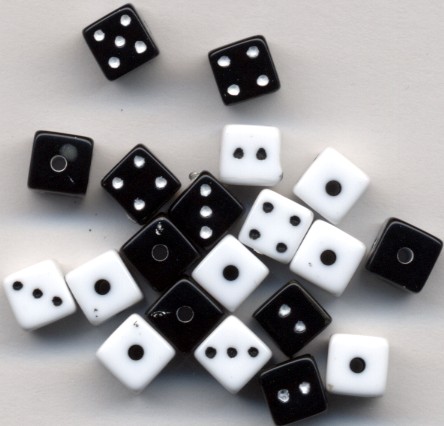
I got together with some friends to play a game of Fiasco the other night. As the game-coordinator was explaining the rules, he said, “Okay, so half the dice are black and half the dice are white. During a scene, any one of you has the option to decide whether the scene concludes well or poorly for the central character — just indicate your choice by placing one of the dice in front of that character. A white die means the scene turns out well, and a black die means it turns out poorly.”

One of the other players interjected: “Could we please not use that color-coding system, where white means good, and black means bad?” The game coordinator quickly replied, “Oh, sure. Let’s switch it around.”

I understood what she was getting at, and it struck me as a case of political correctness carried to an extreme. People’s associations of white/good, black/bad pre-date any intermingling of white people and black people, so it seems absurd to attribute those associations to racism. A more plausible explanation is that the associations with white and black originated in the fact that the blackness of nighttime means we are colder and more vulnerable to danger than we are in the light of day. So this girl’s suggestion that the color coding system was offensive struck me, at the time, as overreaching.

But talking about it later with a friend I re-considered. Even if I’m right about the origins of the white/good black/bad associations, isn’t it still possible that those associations have a subtle impact on how we view white people vs. black people? If we’re used to associating white-the-color with goodness and black-the-color with badness, then is it so implausible to think we might unconsciously apply some of those associations to white-the-race and black-the-race, too?

The question also reminds me of the debate over gender-neutral pronouns. The idea of using “he” as the generic pronoun, to refer to a person of unspecified gender, has been accused of being sexist. Attempts to coin a new pronoun for use in such cases have so far been a failure (en? hir? hesh? hizer? hirm? sheehy?).

And my initial inclination is just to say, look, everyone understands that when we say “mankind” we mean all men AND women, and that when we say “fireman” we mean a firefighter of either gender. Right? I mean, why change the way we speak?

But now I’m a little more willing to believe that there could be a small effect of our language on the way we think. If the mental picture you get when you say “mankind” is of men, then mightn’t you be more inclined to think of women as incidental to the course of history? If your mental picture of a firemanr is always a man, then mightn’t you be more inclined to think men make better firefighters? Or to think it’s unfeminine to fight fires because you associate that activity with men (due to our language)?

I’m not even making the argument that this effect does exist, only that it’s a reasonable hypothesis. And I’m also not making the argument that it would be worth the trouble to rewire our language in the hopes of rewiring our brains. But I am acknowledging that it’s not entirely ludicrous, politically-correct histrionics to say that there could be a causal relationship between these words and our perceptions of the world.