Memory Palaces

Temple_of_Music_Fludd_Complete0202Joshua Foer, this year’s winner at the U.S.A. Memory Championship, wrote an article for the New York Times last month called “Secrets of a Mind-Gamer,” about how he got sucked into the world of competitive memorizing, and the techniques he used to set the national record: memorizing every card in a deck, in order, in only 1 minute 55 seconds. It’s an amusing read (I have a soft spot for tales of quirky competitive subcultures.)

Even if you don’t have Memory Champion aspirations, the article still has some useful takeaways, especially if — like me — you are dismayed by the pitifully small fraction of what you read that you can actually recall, even a day later. In particular, Foer explains that fMRI scans of the brains of trained memorizers (or “memory athletes”) show no significant differences from those of regular untrained people, when both groups were asked to memorize numbers, or pictures of snowflakes, or faces. The only significant difference was that the memory athletes’ brains showed stronger activity in the parts of the brain associated with spatial memory.

Foer ties this back to an allegedly true story about a Greek poet, Simonides of Ceos, in the fifth century B.C.:

After a tragic banquet-hall collapse, of which he was the sole survivor, Simonides was asked to give an account of who was buried in the debris.  When the poet closed his eyes and reconstructed the crumbled building in his imagination, he had an extraordinary realization: he remembered where each of the guests at the ill-fated dinner had been sitting. Even though he made no conscious effort to memorize the layout of the room, it nonetheless left a durable impression. From that simple observation, Simonides reportedly invented a technique that would form the basis of what came to be known as the art of memory. He realized that if there hadn’t been guests sitting at a banquet table but, say, every great Greek dramatist seated in order of birth — or each of the words of one of his poems or every item he needed to accomplish that day — he would have remembered that instead. He reasoned that just about anything could be imprinted upon our memories, and kept in good order, simply by constructing a building in the imagination and filling it with imagery of what needed to be recalled. This imagined edifice could then be walked through at any time in the future. Such a building would later come to be called a memory palace.

Memory palaces don’t have to be actual palaces, Foer says. They can be a familiar road through your hometown, or even your own body. The trick is just to associate each fact you want to memorize with some part of the memory “palace” — with a store or restaurant on the road, for example, or with a part of your body. That allows you to piggyback off of your brain’s built-in knack for spatial memory, for remembering where things are in relation to each other.

The idea of memory palaces resonated with me — I noticed way back in middle school that when I was taking an exam and trying to remember some bit of information, it would help me to visualize the layout of the pages and try to “see” where the fact was on the page, or in the chapter. That would help bring it back.

And more recently, my friend was recounting a detailed, several-hour long conversation he’d had with someone, and I expressed surprise that he was able to remember all the details of the conversation so well. He replied: “I think it has to do with the fact that my friend and I were on a hike while we talked. Because I can picture where we were as we were talking about each topic in turn.” Yet another good reason to spend afternoons with your most interesting friends wandering outside, now that the weather’s getting warmer… as if I needed any more encouragement to be a flaneuse.
Teaching the scientific method, with magic

(Written for 3 Quarks Daily)

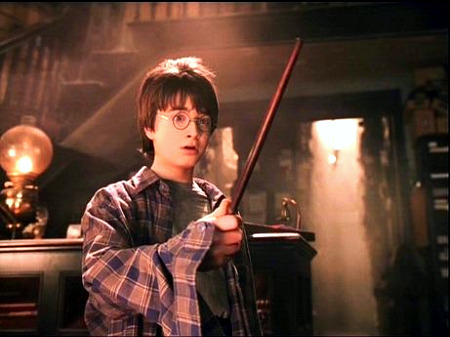
If you wanted to teach people about science, you probably wouldn’t set out to write a fantasy novel. But the exceptional Harry Potter and the Methods of Rationality – an ongoing series of online “fan fiction” by Eliezer Yudkowsky – borrows J.K. Rowling’s world and uses it as a vessel for a sophisticated guide to scientific thinking, while simultaneously crafting a far cleverer and more imaginative story than the original.

Harry Potter and the Methods of Rationality isn’t primarily interested in teaching readers the “what” of science, even though it is liberally sprinkled with interesting facts about genetics, game theory, quantum mechanics, and psychology, among other things. Instead, as the title suggests, it’s about the “how” of science, conceived of not in the narrow sense of research in a laboratory, but in the broader sense of the process of figuring out how anything in the world works.

Like his counterpart in the original series, this Harry Potter is a seemingly ordinary British boy who is thrust into the magic world at the age of eleven. But unlike the mistreated waif of the original series, this Harry has grown up with caring, intellectual parents who bought him all the books he wanted and encouraged his analytic instincts. So when he finds himself plunged into a new, magical world, he immediately starts using that training to find the answers to a host of new questions that confront him: Who can I trust? Why are some people able to do magic and others not? Is there an afterlife? What are ghosts? And how does magic actually work?

Magic may not operate by the logic we’re used to in our world, Harry reasons, but it must operate by some logic. His attempts to methodically figure out what that is are some of the most intellectually enjoyable parts of the series. For example, it appears that you can cause a target to levitate by uttering the magic phrase “Wingardium Leviosa.” But what’s doing the actual work: the sounds made by the spellcaster’s mouth, or the concept in the spellcaster’s head?

Read the rest at 3 Quarks Daily.

“No problem!” Michio Kaku predicts our sci-fi future.

On Wednesday night I went to the Strand to hear celebrity physicist Michio Kaku promote his new book, “Physics of the Future: How Science will Change Daily Life by 2100.”

I know Kaku is supposed to be a real heavyweight in the physics community — he co-founded string field theory — so I was surprised to hear him talking like the kind of giddy, incautious futurist that gave futurism a bad name: “By 2100, our destiny is to become like the gods we once worshiped and feared.” He even had a catch phrase, like a salesman: No problem. (For example: “Lose your hand in an accident? No problem! Scientists will create a new mechanical hand that can touch and feel.” ).

I’m willing to believe that it’s possible to make certain predictions about the near- to medium-term future with some confidence. But bad prognosticating is so easy and so common that my skepticism is on a hair trigger, and hyperbole and flowery language set it off immediately.

I flipped through Kaku’s book after the talk to see whether my first impression was accurate. Indeed, the book is full of grandiose claims about telekinesis, immortality, and avatars on far away planets. He tempers them with plentiful qualifiers like “may,” “might,” and “could.” But that doesn’t change the fact that he offers no evidence that some of the new technologies he’s describing are going to happen at all, let alone in the next 90 years.

Take this claim, for example: “By midcentury, the era of emotional robots may be in full flower.” Kaku describes how victims of brain injury whose emotional centers were severed from their cerebral cortices became incapable of making choices; everything had the same value to them. Emotion plays a crucial role in human decisionmaking, and Kaku makes the case that it would be critical to intelligent robot decisionmaking as well.

But the fact that instilling robots with emotion would make them more effective isn’t evidence that such a feat would be possible by 2100, or ever. There is a recently created robot called KISMET whose face can mimic a wide range of emotions, but, Kaku acknowledges, “scientists have no illusion that the robot actually feels emotions.” So there’s nothing, at least in this book, that backs up Kaku’s original claim about an “era of emotional robots” flowering this century.

Another claim that raised my eyebrows was that of telekinesis: later this century, Kaku says, we’ll be able to move things around with our minds. How will we do this? “In the future, room-temperature superconductors may be hidden inside common items, even nonmagnetic ones,” Kaku writes. “If a current is turned on within the object, it will become magnetic and hence it can be moved by an external magnetic field that is controlled by your thoughts.”

But there’s no evidence that room temperature superconductivity is even possible. Currently, the world record high temperature for superconductors is -211 degrees Fahrenheit. And we don’t even understand the science behind that success, Kaku says — so as far as I can tell, there’s no way to know how much higher we’ll be able to bring the record.

I don’t have any problem with speculation about radical new technologies. But that speculation should be framed as, “This is something that is theoretically possible,” not as “This will probably happen in the next X years.” Attaching a date to your speculation implies a precision which is, in Kaku’s and in most cases of future forecasting, deceptive.

“More like OKStupid, amirite?”

That was the subject line of an email my friend James sent me yesterday. His email contained a link to this post by OK Cupid’s blog, where the OKC team sifts through their massive amounts of data to find interesting facts about people’s dating habits.

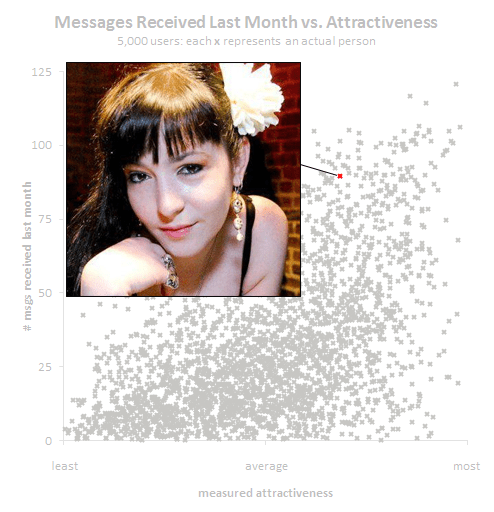
This latest post is called “The Mathematics of Beauty” and it purports to reveal a startling finding: women whose looks inspire a lot of disagreement among men (i.e., with some men rating them hot and others rating them ugly) get more messages. And the number of messages you receive is positively correlated with the number of men rating you a “5 out of 5,” but is negatively correlated with the number of men rating you a “4 out of 5.”  OK Cupid says, “This is a pretty crazy result, but every time we ran the numbers—changing the constraints, trying different data samples, and so on—it came back to stare us in the face.”

To explain these odd results, the OKCupid bloggers came up with two game theoretic stories: First, men who see a woman and think “She’s a 4” will also think “That’s cute enough for plenty of other men to be into her, so I’ll have lots of competition… but that’s not hot enough for it to be worth it for me to try anyway.” And second, if men think, “She’s really hot to me, but I bet other men will disagree,” they’ll be more likely to message her, because they expect less competition. So women with a polarizing look will turn off some men, but the men who are turned on will be even more likely to message her knowing that other men are turned off.

Based on these stories, OKCupid offers the following advice to its female users who want to get more messages from men:

“We now have mathematical evidence that minimizing your “flaws” is the opposite of what you should do. If you’re a little chubby, play it up. If you have a big nose, play it up. If you have a weird snaggletooth, play it up: statistically, the guys who don’t like it can only help you, and the ones who do like it will be all the more excited.”

Oh my. That sounds like really bad advice. Before people start enthusiastically pointing the camera at their fat rolls, maybe we should check and make sure this analysis is sound. Because my opinion is that OKCupid’s crazy results can easily be explained by much less counterintuitive stories than the ones they concoct.

First of all, the “attractiveness” ratings they’re using aren’t really attractiveness ratings. They come from a feature on the site called Quickmatch, which presents you with the profile pictures of a succession of people for you to rate from 1 to 5. But you’re free to click through to each person’s full profile. And if you like the way they present themselves through the written part of the profile, you might well rate them highly on Quickmatch; conversely, if you don’t like their written profiles, you might well rate them poorly. Treating those scores as pure “attractiveness” ratings is way off the mark.

Second of all, the way Quickmatch works is that if you rate someone a 4 or 5 and they similarly rate you a 4 or 5, then you both receive emails informing you of each other’s interest. So this data is even more tainted, because people are not simply thinking “How attractive is this person?” — they’re thinking “Do I want this person to contact me?” If you think someone’s not that attractive but you’d still want to date her, you might well rate her a 4 just in case she’s also interested in you.

In fact, I strongly suspect there are a lot of guys who just rate every single girl a 4 or 5, giving 5’s to the girls they think are good-looking and 4’s to everyone else. It’s a carpet-bombing strategy — why rule anyone out off the bat? (My suspicion is grounded in some results from a speed-dating study I worked on in college, with a psychology professor at Columbia; I got to look at the ratings sheets after each speed dating session, and there were plenty of guys who just circled the entire row of “YES” rather than circling YES or NO to each girl individually.)

And as you can imagine, if a lot of guys are using “4” to mean “anyone who’s not a 5,” then of course 4’s are going to be negatively correlated with the number of messages a girl gets, because many or most of those 4’s actually indicate 1’s, 2’s, and 3’s.

What I think the OKCupid blog post illustrates is how easy it is to come up with a story to explain any result, whether or not the result is real. To paraphrase my friend James for a minute: if you find yourself saying “I know this is crazy, but numbers don’t lie,” you should really calm down and check to see if you’ve made a mistake, because chances are, you have.

The Tuned Deck

In Sweet Dreams: Philosophical Objections to a Science of Consciousness, Daniel Dennett recounts the story of “The Tuned Deck,” a mysterious magic trick that’s more — or less? — than it seems. Conjurer Ralph Hull performed it over and over throughout his life, challenging his fellow magicians to figure out how it was done. Here’s Dennett’s account of how Hull’s act went:

“Boys, I have a new trick to show you. It’s called ‘The Tuned Deck’. This deck of cards is magically tuned [Hull holds the deck to his ear and riffles the cards, listening carefully to the buzz of the cards]. By their finely tuned vibrations, I can hear and feel the location of any card. Pick a card, any card… [The deck is then fanned or otherwise offered for the audience, and a card is taken by a spectator, noted, and returned to the deck by one route or another.] Now I listen to the Tuned Deck, and what does it tell me? I hear the telltale vibrations, … [buzz, buzz, the cards are riffled by Hull’s ear and various manipulations and rituals are enacted, after which, with a flourish, the spectator’s card is presented].

Nobody ever figured out how it was done, and Hull only released the secret posthumously. Dennett explains:

Like much great magic, the trick is over before you even realize the trick has begun. The trick, in its entirety, is in the name of the trick, “The Tuned Deck”, and more specifically, in one word “The”! As soon as Hull had announced his new trick and given its name to his eager audience, the trick was over. Having set up his audience in this simple way, and having passed the time with some obviously phony and misdirecting chatter about vibrations and buzz-buzz-buzz, Hull would do a relatively simple and familiar card presentation trick of type A (at this point I will draw the traditional curtain of secrecy; the further mechanical details of legerdemain, as you will see, do not matter).

His audience, savvy magicians, would see that he might possibly be performing a type A trick, a hypothesis they could test by being stubborn and uncooperative spectators in a way that would thwart any attempt at a type A trick. When they then adopted the appropriate recalcitrance to test the hypothesis, Hull would ‘repeat’ the trick, this time executing a type B card presentation trick. The spectators would then huddle and compare notes: might he be doing a type B trick? They test that hypothesis by adopting the recalcitrance appropriate to preventing a type B trick and still he does “the” trick – using method C, of course. When they test the hypothesis that he’s pulling a type C trick on them, he switches to method D – or perhaps he goes back to method A or B, since his audience has ‘refuted’ the hypothesis that he’s using method A or B.

And so it would go, for dozens of repetitions, with Hull staying one step ahead of his hypothesis-testers, exploiting his realization that he could always do some trick or other from the pool of tricks they all knew, and concealing the fact that he was doing a grab bag of different tricks by the simple expedient of the definite article: The Tuned Deck.

It’s a cool story, but it’s also a relevant lesson for scientific research, or any situation in which you’re testing  theories about what’s causing some phenomenon. If you test each possible cause in isolation, you could end up concluding that none of them are responsible for the phenomenon — but in fact it could be that two or more of them are at work, either simultaneously or at different times, and so when you remove one at a time you’re not changing anything. You’d have to remove both at once to see the effect.

I was reminded of the Tuned Deck recently when my friend and I were having trouble with our Skype video chats getting dropped or becoming pixelated and distorted. We came up with a list of possible reasons it was happening: (1) Maybe the connection is weak in this room? (2) Maybe the time of day is a busy one for the Skype servers? (3) Maybe our computer has too many applications running in the background? etc. And we tested each reason in succession, ruling each one out in turn.

But what if there were different reasons Skype was failing at different times? Maybe the time we tested hypothesis (3) by closing all the background applications, it didn’t fix our video chats because we were chatting at a busy time of day. And then the time we tested hypothesis (1) by moving our laptop closer to the router, it didn’t help because we still had too many applications running in the background. So we ruled out both hypotheses, unjustifiably. (Until eventually I exclaimed “Wait a minute! The Tuned Deck!” and we had to overhaul our entire hypothesis-testing protocol.)

The Merchant and the Alchemist’s Gate

The Merchant and the Alchemist’s Gate is an elegant time travel story by one of my all-time favorite science fiction writers, Ted Chiang. I think it’s really hard to write an internally consistent time travel story (i.e., one in which you can’t change your future) which also (1) is surprising, and (2) doesn’t feel contrived. The problem with most such stories is that you know ahead of time what the destination has to be, so all of the events which inexorably push things towards that destination often feel contrived, like you can see that the author made them happen for the purposes of the narrative. Which is a deathblow to fiction. By contrast, the events in Chiang’s stories don’t feel forced, even as they preserve temporal consistency.

I also appreciate that it lacks the moralizing tone that a lot of time travel stories have. In so many stories, there’s this distasteful undercurrent of, “You were arrogant enough to think you could escape your fate? Well, joke’s on you. You’re just as screwed as you were before (or worse).” Chiang’s stories don’t punish the characters for experimenting with time.

And the nested story structure is lovely — a nice nod to Scheherazade and the Thousand and One Nights.

A philosopher of religion calls it quits

My latest article, for Religion Dispatches, examines the controversy generated last fall when philosopher of religion Keith Parsons quit the field and declared the theistic arguments to be hopelessly fallacious. The article also delves into the different approaches to philosophy of religion — are we trying to answer questions of the form “Is X true?” or of the form “If X were true, what would follow from that?”

Keith Parsons himself now has a blog post up about my piece, and responds to some comments readers left at RD. There’s also a comment thread about the article going at Jerry Coyne’s blog, Why Evolution is True.

The historian’s fallacy

Historians’ Fallacies has a bunch of good examples of hindsight bias in writing history. Writing history, we often make events seem really significant if they turned out to play an important role in the course of history, but often those events went largely unnoticed at the time. Art historian Bernard Berenson summed up this fallacious way of thinking nicely: “Significant events are those events that have contributed to making us what we are today.”

For example, even though historians often describe the buildup to WWI as a series of “mounting tensions” and “escalating crises,” the war was actually much more of a surprise than we think. As Nicholas Nassim Taleb describes in The Black Swan, historian Niall Ferguson demonstrated this cleverly by examining the prices of imperial bonds — imperial bond prices normally decline if investors anticipate a war, because wars cause deficits, but they show no such decline in the months before WWI.

You can also see the historian’s fallacy sometimes in the way historians write about a historical figure’s behavior and motivations as if he knew the role he played in history. (For example, writing about John Adams as if he thought of himself as a Founding Father, and interpreting his speeches and letters as if he knew how the Republic would develop.) But I kind of like the way some historians have found to compensate: the “fog-of-war” technique, in which they give their readers only as much information about the unfolding situation as the historical figure himself knew at that time.

The reversible reference

A nice tip from Historians’ Fallacies: Watch out for pseudo-evidence, facts that are being used to support a claim but which could just as easily have been used to support that claim’s inverse. The book gives the example of one historian who made the claim that the early American colonists regularly threw trash on their streets. How do we know this? Well, the historian argues: New Amsterdam passed a law against littering in 1657, which was enforced on at least one person; and the city instituted weekly trash removal in 1670.
Notes Fischer: “Each of these impressionistic snippets of pseudo-factual information is consistent with a thesis that (1) the streets of New Amsterdam were knee-deep in trash, or (2) the streets of New Amsterdam were kept spotlessly clean by the tidy dutch inhabitants, by means of laws which were enforced and by regular trash removal; or (3) any statement between these two extremes.”

Policing our language

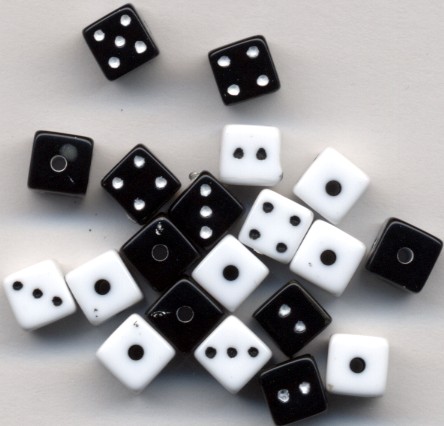
I got together with some friends to play a game of Fiasco the other night. As the game-coordinator was explaining the rules, he said, “Okay, so half the dice are black and half the dice are white. During a scene, any one of you has the option to decide whether the scene concludes well or poorly for the central character — just indicate your choice by placing one of the dice in front of that character. A white die means the scene turns out well, and a black die means it turns out poorly.”

One of the other players interjected: “Could we please not use that color-coding system, where white means good, and black means bad?” The game coordinator quickly replied, “Oh, sure. Let’s switch it around.”

I understood what she was getting at, and it struck me as a case of political correctness carried to an extreme. People’s associations of white/good, black/bad pre-date any intermingling of white people and black people, so it seems absurd to attribute those associations to racism. A more plausible explanation is that the associations with white and black originated in the fact that the blackness of nighttime means we are colder and more vulnerable to danger than we are in the light of day. So this girl’s suggestion that the color coding system was offensive struck me, at the time, as overreaching.

But talking about it later with a friend I re-considered. Even if I’m right about the origins of the white/good black/bad associations, isn’t it still possible that those associations have a subtle impact on how we view white people vs. black people? If we’re used to associating white-the-color with goodness and black-the-color with badness, then is it so implausible to think we might unconsciously apply some of those associations to white-the-race and black-the-race, too?

The question also reminds me of the debate over gender-neutral pronouns. The idea of using “he” as the generic pronoun, to refer to a person of unspecified gender, has been accused of being sexist. Attempts to coin a new pronoun for use in such cases have so far been a failure (en? hir? hesh? hizer? hirm? sheehy?).

And my initial inclination is just to say, look, everyone understands that when we say “mankind” we mean all men AND women, and that when we say “fireman” we mean a firefighter of either gender. Right? I mean, why change the way we speak?

But now I’m a little more willing to believe that there could be a small effect of our language on the way we think. If the mental picture you get when you say “mankind” is of men, then mightn’t you be more inclined to think of women as incidental to the course of history? If your mental picture of a firemanr is always a man, then mightn’t you be more inclined to think men make better firefighters? Or to think it’s unfeminine to fight fires because you associate that activity with men (due to our language)?

I’m not even making the argument that this effect does exist, only that it’s a reasonable hypothesis. And I’m also not making the argument that it would be worth the trouble to rewire our language in the hopes of rewiring our brains. But I am acknowledging that it’s not entirely ludicrous, politically-correct histrionics to say that there could be a causal relationship between these words and our perceptions of the world.