A Sleeping Beauty paradox

Imagine that one Sunday afternoon, Sleeping Beauty is taking part in a mysterious science experiment. The experimenter tells her:

“I’m going to put you to sleep tonight, and wake you up on Monday. Then, out of your sight, I’m going to flip a fair coin. If it lands Heads, I will send you home. If it lands Tails, I’ll put you back to sleep and wake you up again on Tuesday, and then send you home. But I will also, if the coin lands Tails, administer a drug to you while you’re sleeping that will erase your memory of waking up on Monday.”

So when she wakes up, she doesn’t know what day it is, but she does know that the possibilities are:

  • It’s Monday, and the coin will land either Heads or Tails.
  • It’s Tuesday, and the coin landed Tails.

We can rewrite the possibilities as:

  • Heads, Monday
  • Tails, Monday
  • Tails, Tuesday

I’d argue that since it’s a fair coin, you should place 1/2 probability on the coin being Heads and 1/2 on the coin being  Tails. So the probability on (Heads, Monday) should be 1/2. I’d also argue that since Tails means she wakes up once on Monday and once on Tuesday, and since those two wakings are indistinguishable from each other, you should split the remaining 1/2 probability evenly between (Tails, Monday) and (Tails, Tuesday). So you end up with:

  • Heads, Monday  (P = 1/2)
  • Tails, Monday (P = 1/4)
  • Tails, Tuesday  (P = 1/4)

So, is that the answer? It seems indisputable, right? Not so fast. There’s something troubling about this result. To see what it is, imagine that Beauty is told, upon waking, that it’s Monday. Given that information, what probability should she assign to the coin landing Heads? Well, if you look at the probabilities we’ve assigned to the three scenarios, you’ll see that conditional on it being Monday, Heads is twice as likely as Tails. And why is that so troubling? Because the coin hasn’t been flipped yet. How can Beauty claim that a fair coin is twice as likely to come up Heads as Tails?

Can you figure out what’s wrong with the reasoning in this post?

RS #47: The Search for Extra-Terrestrial Intelligence

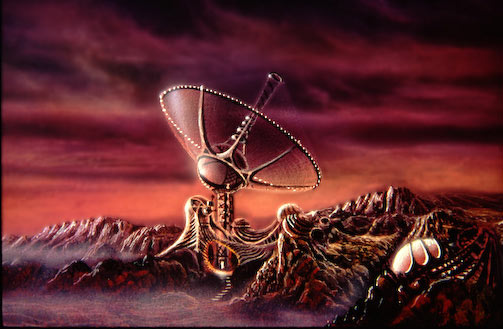
In the latest episode of Rationally Speaking, Massimo and I spar about SETI, the Search for Extra-Terrestrial Intelligence: Is it a “scientific” endeavor? Is it worth maintaining? How would we find intelligent alien life, if it’s out there?

My favorite parts of this episode are the ones in which we’re debating how likely it is that intelligent alien life exists. Massimo’s opinion is essentially that we have no way to answer the question; I’m less pessimistic. There are a number of scientific facts which I think should raise or lower our estimates of the prevalence of intelligent alien life. And what about the fact of our own existence? Does that provide any evidence we can use to reason about the likelihood of our ever encountering other intelligent life? It’s a very tricky question, fraught as it is with unresolved philosophical problems in probability theory, but a fascinating one.

RS #47: The Search for Extra-Terrestrial Intelligence

The Penrose Triangle of Beliefs

For a long time, I didn’t think it was truly possible to believe contradictory things at the same time. In retrospect, the model I was using of belief-formation was roughly: when people decide that they believe some new claim, it’s because they’ve compared it to their pre-existing beliefs and found no contradictions. Of course, that may be how an ideal-reasoning Artificial Intelligence would build up its set of beliefs*, but we’re not ideal reasoners. It’s not at all difficult to find contradictions in most anyone’s belief set. Just for example,

  1. “The Bible is the word of God.”
  2. “The Bible says you’ll go to hell if you don’t accept Jesus.”
  3. “My atheist friends aren’t going to hell, they’re good people.”

Or – to take an example I’ve witnessed many times:

  1. “The reason it’s not okay to have sex with animals is because they can’t consent to it.”
  2. “Animals can’t consent to being killed and eaten.”
  3. “It’s fine to kill and eat animals.”

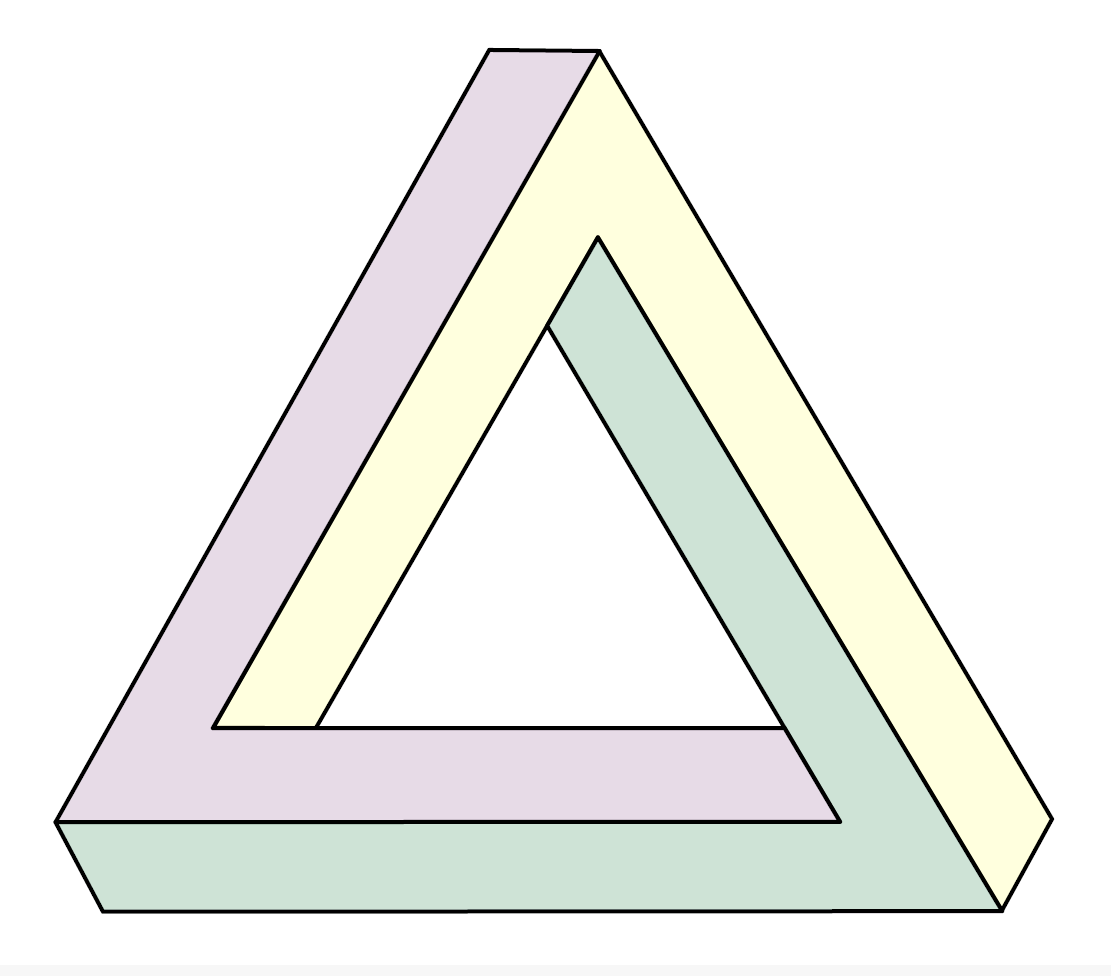
Anyway, despite the fact that I had overwhelming evidence demonstrating that, yes, people are quite capable of believing contradictory things, I was having a hard time understanding how they did it. Until I took another look at an old optical illusion called the Penrose Triangle.

The Penrose Triangle

If you look at the whole triangle at once, you can’t see it in enough detail to notice its impossibility. All you can do, at that zoomed-out level, is get a sense of whether it looks, roughly, like a plausible object. And it does.

Alternatively, you can look closely at one part of the picture at a time. Then you can actually check the details of the picture to make sure they make sense, rather than relying on the vague “feels plausible” kind of examination you did at the zoomed-out holistic level. But the catch is that in order to scrutinize the picture in detail, you have to zoom in to one subset of the picture at a time – and each corner of the triangle, on its own, is perfectly consistent.

And I think that the Penrose triangle is an apt visual metaphor for what contradictory beliefs must look like in our heads. We don’t notice the contradictions in our beliefs because we either “examine” our beliefs at the zoomed-out level (e.g., asking ourselves, “Do my beliefs about God make sense?” and concluding “Yes” because no obvious contradictions jump out at us in response to that query)… or we examine our beliefs in detail, but only a couple at a time. And so we never notice that our beliefs form an impossible object.

*(Well, to be more precise, you’d probably want an ideal-reasoning AI to assign degrees of belief, or credence, to claims, rather than a binary “believe”/”disbelieve.” So then the way to avoid contradictions would be to prohibit your AI from assigning credence in a way that violated the laws of probability. So, for example, it would never assign 99% probability to A being true and 99% probability to B being true, but only 5% probability to “A and B being true.”)

What is “objectification,” and what’s wrong with it?

I was pleased to discover that one of my favorite bloggers, Luke Muehlhauser, had recently tackled a topic that’s been on my mind too: what do people mean when they talk about men “objectifying” women, and why exactly is it a bad thing? As per usual with Luke’s posts, it’s a clear-headed and thoughtful analysis, and it’s obvious that he isn’t trying to attack anyone — just genuinely trying to parse the concept and determine the degree to which it makes sense.

Luke lists several typical ways people define “objectification,” most of which center around the idea of treating another person as a means to an end, without being conscious of their feelings and goals and preferences. I’ve always felt this is an odd definition for two reasons, both of which Luke raises: First, it seems like an incomplete definition, in that there are many cases that match that definition perfectly but which no one would call instances of objectification (Luke has a clever photographic example).

And second, if objectification is “using someone as a means to an end,” it isn’t clear why objectification is inherently bad, even though the word typically carries a strong connotation of condemnation. After all, we all use each other as means to an end all the time! When I buy a cup of coffee, I’m treating the barista as a means to the end of getting a cup of coffee. I’m not really thinking about his feelings or goals — and I don’t think he expects or particularly wants me to be.

Of course, if not-thinking about someone’s feelings means that you harm him (like if I were rude to the barista) then it’s easy to see why that’s bad. But the proper conclusion from that fact is “harming people is bad,” not “objectification is bad.” It’s certainly possible to use someone as a means to an end without harming him, and so it’s still not clear why objectification per se is bad.

At least, that’s the form my argument typically took until yesterday. I thought about it a bit more after reading Luke’s analysis, and concluded that I had been missing part of the picture. So to the extent that I’m now sympathetic to arguments against objectification, it’s for this reason:

Objectification’s not necessarily a problem at the individual level. When Person A uses Person B as a means to an end, as long as B’s not being harmed, then it’s ethically unproblematic (at least for us utilitarian-minded folks). The tricky thing is that when you have a lot of A’s systematically treating a lot of B’s as a means to an end in the same kind of way, it can start to become a problem. Because at that scale, it can affect the way A’s and B’s think about each other — people’s attitudes are influenced by the way the people around them think and act. So it can have this self-reinforcing ripple effect that ends up stifling other kinds of interactions and relationships that many A’s and B’s would’ve found fulfilling.

So, that’s my current theory. It’s the best I can do at reconciling the facts that (1) I’m not at all bothered by the idea of a particular man being interested in a particular woman only for sex, and (2) I hate the idea of a society in which most men are only interested in women for sex (and I think such a society would be seriously sub-optimal for both men and women).*

I think this is a very under-appreciated aspect of the objectification debate. I also think it poses interesting problems for utilitarian ethics; how do you assign blame in situations where any single person doing X is harmless, but many people doing X is harmful? It’s somewhat akin to problems like pollution, where each individual actor can truthfully argue, “Given that everyone else is polluting, it’s not going to make any difference if I do it too.”

And with objectification, not only do you have the fact that no single person’s actions are going to measurably change the overall culture, you also have the fact that the overall culture is partly to blame for each individual’s actions. And all of the individuals’ actions, in turn, are to blame for the overall culture. The circularity makes it especially tricky to figure out the degree to which any individual actor deserves blame for his actions.

*Of course, men objectifying women isn’t the only kind of objectification; you could fill in any gender in place of either “men” or “women.” I just used that pairing because it’s the typical one in these discussions, but my argument isn’t actually gender-dependent.

Spinoza, Godel, and Theories of Everything

On the latest episode of Rationally Speaking, Massimo and I have an entertaining discussion with Rebecca Goldstein, philosopher, author, and recipient of the prestigious MacArthur “genius” grant. There’s a pleasing symmetry to her published oeuvre. Her nonfiction books, about people like philospher Baruch Spinoza and mathematician Kurt Godel, have the aesthetic sensibilities of novels, while her novels (most recently, “36 Arguments for the Existence of God: A Work of Fiction”) have the kind of weighty philosophical discussions one typically finds in non-fiction.

It’s a wide-ranging and fun conversation. My main complaint is just over her treatment of Spinoza. Basically, people say he “believed God was nature.” That always made me roll my eyes, because it’s not making a claim about the world, it’s merely redefining the word “God” to mean “nature,” for no good reason. I voice this complaint to Rebecca during the show and she defends Spinoza; you can see what you think of her response, but I felt it to be weak; it sounded like she was just pointing out some dubious similarities between nature and the typical conception of God.

Nevertheless! It’s certainly worth a listen:

http://www.rationallyspeakingpodcast.org/show/rs45-rebecca-newberger-goldstein-on-spinoza-goedl-and-theori.html

Reflections on pain, from the burn unit

Deep frying: even more hazardous to your health than I realized.

Yesterday marked the end of my 18-day stay in New York Presbyterian Hospital’s burn unit, where I landed after accidentally overturning a pot of hot cooking oil onto myself. I ended up with second- and third- degree burns over much of my legs, but after skin graft surgery and some physical therapy, I can walk again, albeit unsteadily, and I have skin on my legs again, albeit ugly skin.

I learned a lot during my hospital stay. Unfortunately, nearly all of that hard-earned knowledge was in very specific topics – the ideal cocktail of pills, the least-uncomfortable position to sleep in, etc. – which will neither be applicable in other contexts nor interesting to other people. But I did leave with one realization about pain, and how we experience it.

I wasn’t in constant pain for the entire 18 days, by any means, but every day featured at least a few painful experiences, from the minor (frequent shots) to the major (scraping the dead skin off the burns). I tried a handful of methods to deal with it. Deep breathing helped a bit, as did pulling my own hair. One friend suggested I try imagining myself existing at a point halfway across the room; that helped a little, but only because our philosophical argument over whether it was even possible to pull off such a mental stunt briefly distracted me from my throbbing legs.

But the one thing that did seem to dramatically affect my pain level was my belief about what was causing the pain. At one point, I was lying on my side and a nurse was pulling a bandage off of one of my burns; I couldn’t see what she was doing, but it felt like the bandage was sticking to the wound, and it was agonizing. But then she said: “Now, keep in mind, I’m just taking off the edges of the bandage here, so this is all normal skin. It just hurts because it’s like pulling tape off your skin.” And once she said that — once I started picturing tape being pulled off of normal, intact skin rather than an open wound — the pain didn’t bother me nearly as much. It really drove home to me how much of my experience of pain is psychological; if I believe the cause of the pain is something frightening or upsetting, then the pain seems much worse.

And in fact, I’d had a similar thought a few months ago, which I’d then forgotten about until the burn experience called it back to mind. I’d been carrying a heavy shopping bag on my shoulder one day, and the weight of the bag’s straps was cutting into the skin on my shoulder. But I barely noticed it. And then it occurred to me that if I had been experiencing that exact same sensation on my shoulder, in the absence of a shopping bag, it would have seemed quite painful. The fact that I knew the sensation was caused by something mundane and harmless reduced the pain so much it didn’t even register in my mind as a negative experience.

Of course, I probably can’t successfully lie to myself about what’s causing me pain, so there’s a limit to how directly useful this observation can be for managing pain in the future. But it was indirectly useful for me, because it proved to me something I’d heard but never quite believed: that the unpleasantness of pain is substantially (entirely?) psychologically constructed. A bit of subsequent reading led me to some fascinating science that underlines that conclusion – for example, the fact that the physical sensation of pain is processed by one region of the brain while the unpleasantness of that sensation is processed by another region. And the existence of a condition called pain asymbolia, in which people with certain kinds of brain damage say they’re able to feel pain but that they don’t find it the slightest bit unpleasant.

The relationship between pain and unpleasantness is a philosophically interesting one, in fact. Unpleasantness is usually considered to be built into the very definition of pain, so it’s quite confusing to talk about experiencing different levels of unpleasantness from the same level of pain. And it’s even more confusing to talk about experiencing no unpleasantness from pain, as people with pain asymbolia do. The idea feels almost as incoherent as that of being happy but not enjoying it, or doubling a number without making it any bigger.

But observing my own experiences of pain a bit more closely has made it a little easier for me to wrap my mind around the idea. I really did feel, when the nurse informed me that she was pulling the bandage off of intact skin rather than burned skin, like the pain was the same but the unpleasantness was lessened. It’s harder to imagine pain with no unpleasantness, but perhaps my shopping bag example sheds a little light: I felt the sensation of something cutting into my shoulder, but it didn’t bother me. So maybe someone with pain asymbolia would experience a cutting sensation as if they’re just carrying a heavy shopping bag, with no “Warning!” and “This is awful!” alarms going off in their mind.

I’ll have to think more about the relationship between pain and the experience of pain, because it’s still confusing to me, but at least I can feel like I got some new philosophical food for thought out of my 18 days at NY Presbyterian. Not to mention the very practical, un-philosophical lesson: don’t leave your giant pots of oil near the edge of the stove.

(ETA: I completely forgot, while writing this, that Jesse had touched on this very subject last month! Wow, Jesse — in retrospect, that’s an eerily prescient post.)

The Social Psychology of Burning Man

(Cross-posted at Scientific American’s Guest Blog.)

I just finished shaking the last of the desert dust out of the bags I brought to this year’s Burning Man, an annual week-long event in Nevada’s Black Rock Desert that takes its name from the burning of a giant effigy at the end of the week.  According to popular perception, Burning Man is a non-stop rave thrown by a bunch of drugged-out naked hippies. That’s not entirely false, admittedly, but it’s only a small piece of the picture.

Burning Man is also a large-scale social experiment. The 50,000 people who converge on the desert each year create a temporary but legitimate city – roughly the size of Santa Cruz, CA or Flagstaff, AZ — with its own street grid, laws, and social mores. In the process, they attempt to do away with several of the most fundamental institutions underlying modern civilization. Clothing, for example, is optional at Burning Man, and many people opt out of it.

Money, on the other hand, is not optional: it’s explicitly banned. People exchange goods and services constantly, but money never changes hands, except in one specially designated central tent which sells coffee and tea. I’ve heard Burning Man sometimes described as a “barter economy,” but that’s not quite right. It’s more of a “gift economy,” in which people give strangers food, drinks, clothing, massages, bike repairs, rides back to camp, and more, all without any expectation of reciprocation. Many attendees also invest a great deal of their own time and money beforehand to make other people’s experiences at Burning Man more beautiful, interesting, and comfortable, setting up tents or couches for public use or crafting elaborate art installations out in the desert for others to discover.

Read the rest at Scientific American.

The darker the night, the brighter the stars?

“The darker the night, the brighter the stars” always struck me as a bit of empty cliche, the sort of thing you say when you want to console someone, or yourself, and you’re not inclined to look too hard at what you really mean. Not that it’s inherently ridiculous that your periods of pleasure might be sweeter if you have previously tasted pain. That’s quite plausible, I think. What made me roll my eyes was the implication that periods of suffering could actually make you better off, overall. That was the part that seemed like an obvious ex post facto rationalization to me. Surely the utility you gain from appreciating the good times more couldn’t possibly be outweighed by the utility you lose from the suffering itself!

Or could it? I decided to settle the question by modeling the functional relationship between suffering and happiness, making a few basic simplifying assumptions. It should look something roughly like this:

Total Happiness = [(1-S) * f(S)] – S

where*
S = % of life spent in suffering
(1-S) = % of life spent in pleasure
f(S) = some function of S

As you can see, f(S) acts as a multiplier on pleasure, so the amount of time you’ve spent in suffering affects how much happiness you get out of your time spent in pleasure. I didn’t want to assume too much about that function, but I think it’s reasonable to say the following:

  • f(S) is positive — more suffering means you get more happiness out of your pleasure
  • f(0) = 1, because if you have zero suffering, there’s no multiplier effect (and multiplying your pleasure by 1 leaves it unchanged).

… I also made one more assumption which is probably not as realistic as those two:

  •  f(S) is linear.**

Under those assumptions, f(S) can be written as:
f(S) = aS + 1

Now we can ask the question: what percent suffering (S) should we pick to maximize our total happiness? The standard way to answer “optimizing” questions like that is to take the derivative of the quantity we’re trying to maximize (in this case, Total Happiness) with respect to the variable we’re trying to choose the value of (in this case, S), and set that derivative to zero. Here, that works out to:

f'(S) – Sf'(S) – f(S) – 1 = 0

And since we’ve worked out that f(S) = aS + 1, we know that f'(S) = a, and we can plug both of those expressions into the equation above:

a – Sa – aS – 1 – 1 = 0
a – 2aS = 2
-2aS = 2 – a
2aS = a -2
S = (a – 2) / 2a

That means that the ideal value of S (i.e., the ideal % of your life spent suffering, in order to maximize your total happiness) is equal to (a – 2)/2a, where a tells you how strongly suffering magnifies your pleasure.

It might seem like this conclusion is unhelpful, since we don’t know what a is. But there is something interesting we can deduce from the result of all our hard work! Check out what happens when a gets really small or really large. As a approaches 0, the ideal S approaches negative infinity – obviously, it’s impossible to spend a negative percentage of your life suffering, but that just means you want as little suffering as possible. Not too surprising, so far; the lower a is, the less benefit you get from suffering, so the less suffering you want.

But here’s the cool part — as a approaches infinity, the ideal S approaches 1/2. That means that you never want to suffer more than half of your life, no matter how much of a multiplier effect you get from suffering – even if an hour of suffering would make your next hour of pleasure insanely wonderful, you still wouldn’t ever want to spend more time suffering than reaping the benefits of that suffering. Or, to put it in more familiar terms: Darker nights may make stars seem brighter, but you still always want your sky to be at least half-filled with stars.

* You’ll also notice I’m making two unrealistic assumptions here:

(1) I’m assuming there are only two possible states, suffering and pleasure, and that you can’t have different degrees of either one – there’s only one level of suffering and one level of pleasure.

(2) I’m ignoring the fact that it matters when the suffering occurs – e.g., if all your suffering occurs at the end of your life, there’s no way it could retroactively make you enjoy your earlier times of pleasure more. It would probably be more realistic to say that whatever the ideal amount of suffering is in your life, you would want to sprinkle it evenly throughout life because your pleasures will be boosted most strongly if you’ve suffered at least a little bit recently.

** Linearity is a decent starting point, and worth investigating, but I suspect it would be more realistic, if much more complicated, to assume that f(S) is concave, i.e., that greater amounts of suffering continue to increase the benefit you get from pleasure, but by smaller and smaller amounts.

Ethics of the sex tape

A friend was telling me last week about a celebrity sex tape that he particularly enjoys. I’m not going to help publicize this tape, for reasons that should become clear from reading my post, but I can sketch out the rough details for you: The woman is a young singer, publicly Christian, and she’s having sex with a married man. The tape was stolen (or hacked, I’m not sure) and leaked to the public. It’s theoretically possible that she leaked it herself for publicity, I suppose, but it seems unlikely given the cheating and the Christianity — it definitely tarnished the public image she’d carefully constructed for herself, in addition to being humiliating simply by virtue of it being a sex tape.

So I asked my friend if he feels any guilt about watching this tape, knowing that the woman didn’t want other people to see it, and we ended up having a friendly debate about whether there was anything ethically problematic about his behavior. Of course, the answer to that depends on what ethical system you’re using. You could, for example, take a deontological approach and declare that it’s just a self-evident principle that we don’t have a right to watch someone else’s private tape. Or alternately, you could take a virtue ethics approach and declare that enjoying the tape, after it’s already been leaked, is exploiting someone else’s misfortune, which isn’t a virtuous thing to do.

But my friend and I are both utilitarians, at heart, and neither of those lines of argument resonated with us. We were concerned, instead, with what I think is a more interesting question: does watching the tape harm the woman? As my friend emphasized, she’ll never know that he watched it. (At least, that’s true as long as he downloads it from Bit Torrent, or some other file-sharing site where the number of views of the video aren’t recorded such that she could ever see how much traffic it’s gotten.)

I agreed, but was still reluctant to conclude that no harm was done. Do I necessarily have to know about something in order for its outcome to matter to me? If you tell me about two possible states of the world, one in which everyone has seen my awful humiliating sex tape, and one in which no one has, I’m going to have a very strong preference for the latter, even if people behave identically towards me in both potential worlds. So maybe it makes more sense to define “harming someone” to mean, “helping create a world which that person would not want to exist, given the option,” rather than “causing that person to experience suffering or disutility.” My friend’s decision to watch the tape harmed the woman according to the first, but not the second, definition.

Then my friend advanced what I had to admit was a pretty clever argument:

“Well, presumably the reason she doesn’t want people to see her tape is that she assumes it will make them think worse of her. But I am totally non-judgmental about sex, and don’t think worse of her at all for having made a sex tape. So even if you think there can be harm done to someone without the person ever knowing about it, still, the ‘harm’ is not in people watching the tape but in them thinking worse of her. Which I didn’t, so — no harm done.”

Of course, it’s hard to speculate about someone’s mental state. Maybe the woman would’ve been embarrassed even if she knew people weren’t judging her poorly for the tape. After all, a lot of people don’t like the idea of someone accidentally seeing them naked. And there’s no danger of someone thinking worse of you if he’s the one who accidentally walked in on you — obviously you didn’t do anything wrong — so the embarrassment people feel in cases like that is clearly just from the fact of being seen naked.

So I suppose I didn’t entirely buy my friend’s argument (I’m not sure he did either, honestly), and I’m still left a bit torn about how to evaluate situations like this. But even if you don’t think you’re causing any harm by watching leaked sex tapes like this one, you’ll have to admit that you are ceding your “right” to complain if something like this ever happens to you. So if I find out that you help yourself to celebrity sex tapes, be warned: if a private sex tape of yours ever finds its way onto the Internet, I’ll have no qualms about watching it.

RS#40: Q&A with Massimo and Julia

The latest episode of the Rationally Speaking podcast is a special one-hour Q&A, in which Massimo and I answer selected questions from our listeners. In this installment the topics include: What would we teach in a class on critical thinking? What are our views on on analytic vs. continental philosophy? Is it ethical to take advantage of a drought to sell water at marked-up prices? How do we compartmentalize our rationality? How does modern technology affect the way we think about things? What is, or should be, the primary purpose of our species? And is there really a rational argument to prove the divine origin of the Bible?

http://www.rationallyspeakingpodcast.org/show/rs40-qa-with-massimo-and-julia.html