

For a long time, I didn’t think it was truly possible to believe contradictory things at the same time. In retrospect, the model I was using of belief-formation was roughly: when people decide that they believe some new claim, it’s because they’ve compared it to their pre-existing beliefs and found no contradictions. Of course, that may be how an ideal-reasoning Artificial Intelligence would build up its set of beliefs*, but we’re not ideal reasoners. It’s not at all difficult to find contradictions in most anyone’s belief set. Just for example,
- “The Bible is the word of God.”
- “The Bible says you’ll go to hell if you don’t accept Jesus.”
- “My atheist friends aren’t going to hell, they’re good people.”
Or – to take an example I’ve witnessed many times:
- “The reason it’s not okay to have sex with animals is because they can’t consent to it.”
- “Animals can’t consent to being killed and eaten.”
- “It’s fine to kill and eat animals.”
Anyway, despite the fact that I had overwhelming evidence demonstrating that, yes, people are quite capable of believing contradictory things, I was having a hard time understanding how they did it. Until I took another look at an old optical illusion called the Penrose Triangle.
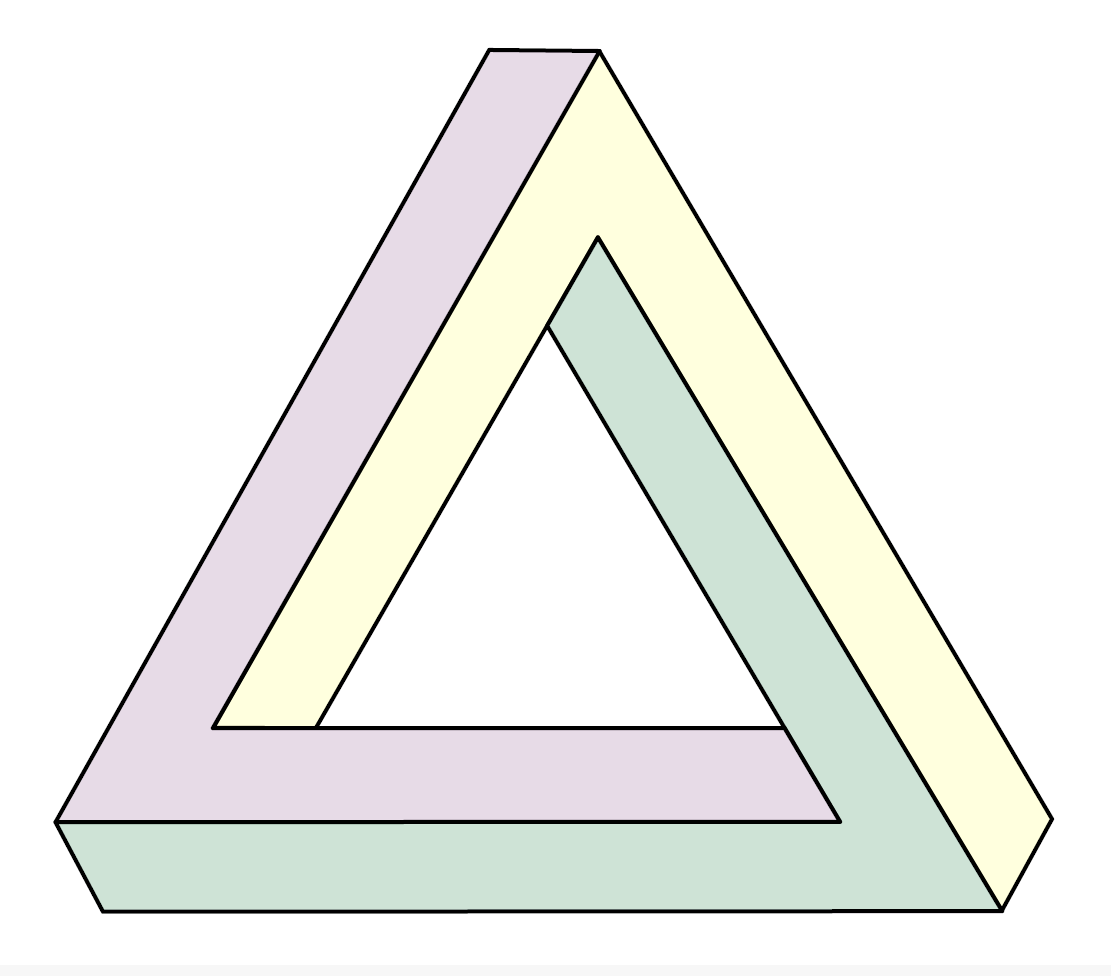
The Penrose Triangle
If you look at the whole triangle at once, you can’t see it in enough detail to notice its impossibility. All you can do, at that zoomed-out level, is get a sense of whether it looks, roughly, like a plausible object. And it does.
Alternatively, you can look closely at one part of the picture at a time. Then you can actually check the details of the picture to make sure they make sense, rather than relying on the vague “feels plausible” kind of examination you did at the zoomed-out holistic level. But the catch is that in order to scrutinize the picture in detail, you have to zoom in to one subset of the picture at a time – and each corner of the triangle, on its own, is perfectly consistent.
And I think that the Penrose triangle is an apt visual metaphor for what contradictory beliefs must look like in our heads. We don’t notice the contradictions in our beliefs because we either “examine” our beliefs at the zoomed-out level (e.g., asking ourselves, “Do my beliefs about God make sense?” and concluding “Yes” because no obvious contradictions jump out at us in response to that query)… or we examine our beliefs in detail, but only a couple at a time. And so we never notice that our beliefs form an impossible object.
*(Well, to be more precise, you’d probably want an ideal-reasoning AI to assign degrees of belief, or credence, to claims, rather than a binary “believe”/”disbelieve.” So then the way to avoid contradictions would be to prohibit your AI from assigning credence in a way that violated the laws of probability. So, for example, it would never assign 99% probability to A being true and 99% probability to B being true, but only 5% probability to “A and B being true.”)