

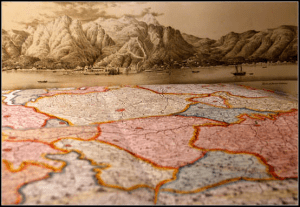

After exploring a bit, Chris called out excitedly. “I found a radio in Section A! Check it out, we’re saved!” His friends came running.
“This is in Section B, not Section A,” said Bruce. “It’s south of the tree line, which is the obvious division between north and south.”
“Of course it’s Section A,” replied Alice. “This is north of the river, which is the way to divide the island.”
Chris shrugged. “I guess we never decided exactly what the border was; I just assumed we were using the river. It’s not like the radio moves based on what section we call this. We agree that it’s north of the river and south of the trees. It’s Section A if we use the river, Section B if we use the forest. Let’s just decide to use one or the other. Neither way is ‘right’ or ‘wrong’; we’re making them up.”
Alice and Bruce weren’t buying it.
“What do you mean, we’re just making it up? The forest is real and the river is real. One of them makes the real boundary between Section A and Section B!”
Chris sat down to use the radio to call for help, leaving his two friends to their bickering.
Alice and Bruce were experiencing the “map and territory” confusion. A map is a mind-made categorization of real things in the territory. It doesn’t make sense to say that the decision to divide the territory in one way or another is “right” or “wrong”, only more or less useful in different contexts.
This comes up all too often in language. Like sections on a map, words are societal tools we use to categorize and communicate the real things we experience. Our society has some well-defined words like ‘hydrogen’ – we have a good shared understanding of exactly which conditions must be met to determine whether or not we should call something ‘hydrogen’.
But the boundaries around other words are hazier. People argue over whether to call something ‘love’, whether to call it ‘art’, and (one of the most contentious) whether to call it ‘moral’. By some definitions, a urinal on a pedestal qualifies as art, by other definitions it doesn’t. Society hasn’t agreed upon clear-cut boundaries for which feelings, objects, or actions fit into those categories. But the arguments are not about reality itself – they’re over the labels, the language map.
In many philosophical discussions, the distinction is muddied or lost. When the Stanford Encyclopedia of Philosophy gives an Analysis of Knowledge and examines whether or not a person “knows” something, they’re really at the ‘map’ level, discussing which facts, principles, and phenomena we choose to group under the label ‘knowledge’.
One such argument is over whether a person can know something without believing it to be true. Philosopher Colin Radford said yes, giving the example of a hypothetical student named Albert who thought he was guessing on a test but actually remembered correctly. Other philosophers such as “Evidentialists” have disagreed, and claimed that it wasn’t knowledge after all because it lacked proper justification. But their argument is like the grad students arguing over whether the radio is in Section A. Nothing about Albert’s confidence level, correctness, or justification for his guess changes based on whether or not it’s labeled “knowledge”.
The best way I’ve found to clear up the confusion is to change the sentence’s subject. Instead of “What is moral?” ask “What things do people call moral?” Instead of “What is it to be a law of nature?” ask “What things do people call laws of nature?” Or, if you want to be meticulous, phrase your question “What conditions must be met for us to call a thing moral?” The new wording highlights the distinction between the label and the things themselves.
It’s important to have words that categorize the world well so we can talk about a concept accurately and clearly. But an argument over the map isn’t an argument about the underlying reality.