

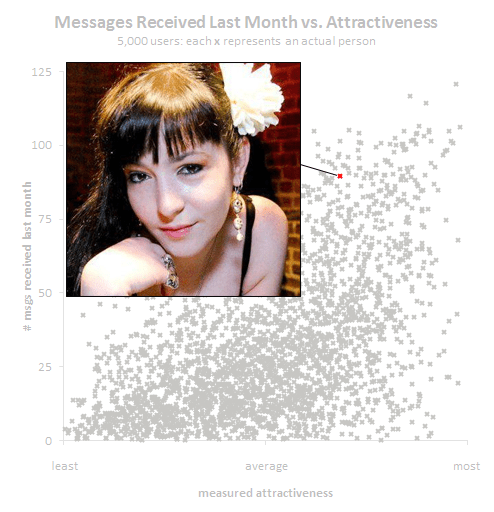
This latest post is called “The Mathematics of Beauty” and it purports to reveal a startling finding: women whose looks inspire a lot of disagreement among men (i.e., with some men rating them hot and others rating them ugly) get more messages. And the number of messages you receive is positively correlated with the number of men rating you a “5 out of 5,” but is negatively correlated with the number of men rating you a “4 out of 5.” OK Cupid says, “This is a pretty crazy result, but every time we ran the numbers—changing the constraints, trying different data samples, and so on—it came back to stare us in the face.”
To explain these odd results, the OKCupid bloggers came up with two game theoretic stories: First, men who see a woman and think “She’s a 4” will also think “That’s cute enough for plenty of other men to be into her, so I’ll have lots of competition… but that’s not hot enough for it to be worth it for me to try anyway.” And second, if men think, “She’s really hot to me, but I bet other men will disagree,” they’ll be more likely to message her, because they expect less competition. So women with a polarizing look will turn off some men, but the men who are turned on will be even more likely to message her knowing that other men are turned off.
Based on these stories, OKCupid offers the following advice to its female users who want to get more messages from men:
“We now have mathematical evidence that minimizing your “flaws” is the opposite of what you should do. If you’re a little chubby, play it up. If you have a big nose, play it up. If you have a weird snaggletooth, play it up: statistically, the guys who don’t like it can only help you, and the ones who do like it will be all the more excited.”
Oh my. That sounds like really bad advice. Before people start enthusiastically pointing the camera at their fat rolls, maybe we should check and make sure this analysis is sound. Because my opinion is that OKCupid’s crazy results can easily be explained by much less counterintuitive stories than the ones they concoct.
First of all, the “attractiveness” ratings they’re using aren’t really attractiveness ratings. They come from a feature on the site called Quickmatch, which presents you with the profile pictures of a succession of people for you to rate from 1 to 5. But you’re free to click through to each person’s full profile. And if you like the way they present themselves through the written part of the profile, you might well rate them highly on Quickmatch; conversely, if you don’t like their written profiles, you might well rate them poorly. Treating those scores as pure “attractiveness” ratings is way off the mark.
Second of all, the way Quickmatch works is that if you rate someone a 4 or 5 and they similarly rate you a 4 or 5, then you both receive emails informing you of each other’s interest. So this data is even more tainted, because people are not simply thinking “How attractive is this person?” — they’re thinking “Do I want this person to contact me?” If you think someone’s not that attractive but you’d still want to date her, you might well rate her a 4 just in case she’s also interested in you.
In fact, I strongly suspect there are a lot of guys who just rate every single girl a 4 or 5, giving 5’s to the girls they think are good-looking and 4’s to everyone else. It’s a carpet-bombing strategy — why rule anyone out off the bat? (My suspicion is grounded in some results from a speed-dating study I worked on in college, with a psychology professor at Columbia; I got to look at the ratings sheets after each speed dating session, and there were plenty of guys who just circled the entire row of “YES” rather than circling YES or NO to each girl individually.)
And as you can imagine, if a lot of guys are using “4” to mean “anyone who’s not a 5,” then of course 4’s are going to be negatively correlated with the number of messages a girl gets, because many or most of those 4’s actually indicate 1’s, 2’s, and 3’s.
What I think the OKCupid blog post illustrates is how easy it is to come up with a story to explain any result, whether or not the result is real. To paraphrase my friend James for a minute: if you find yourself saying “I know this is crazy, but numbers don’t lie,” you should really calm down and check to see if you’ve made a mistake, because chances are, you have.